
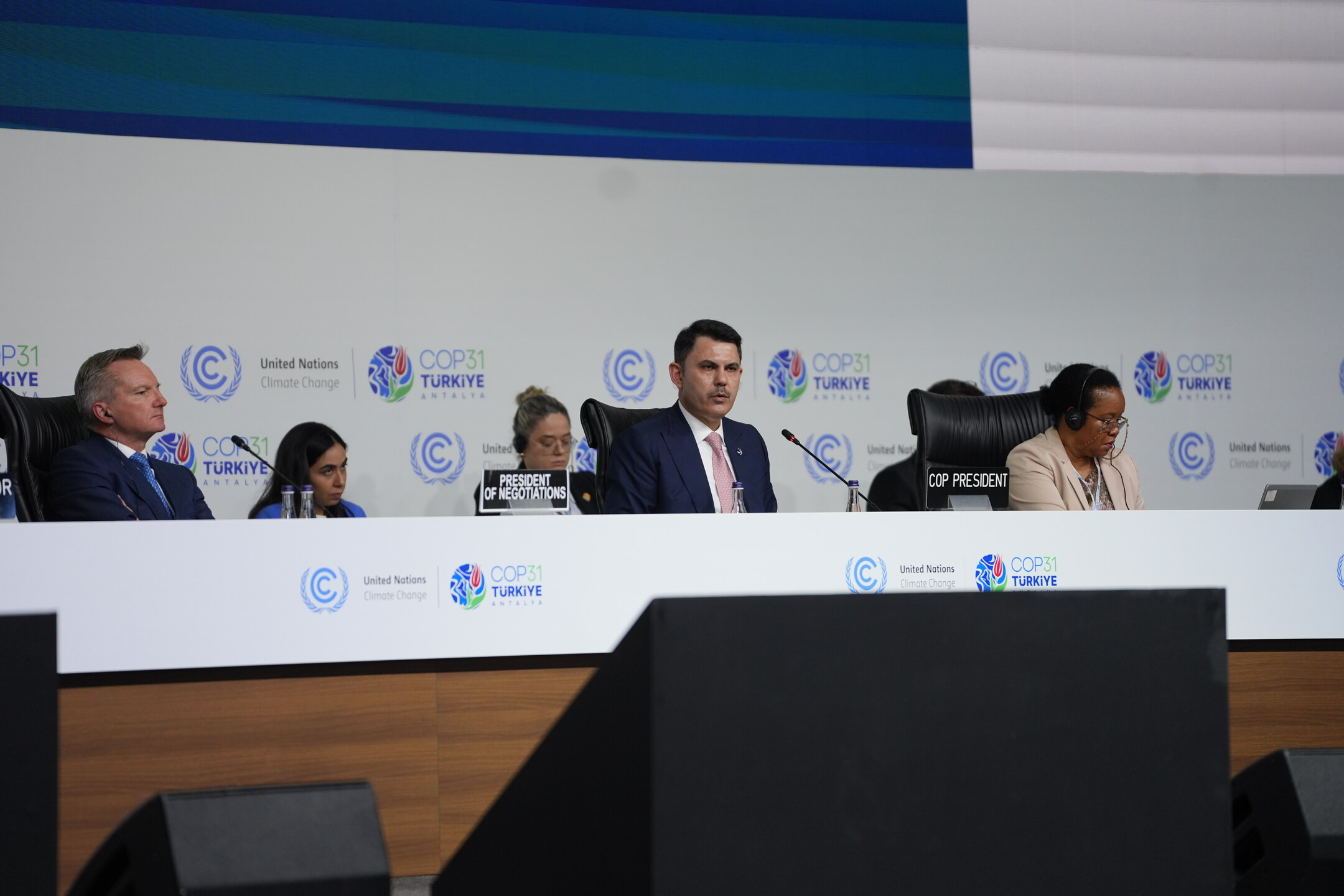
The last draft set out goals for electrification and carbon capture, but left out a direct reference to moving away from fossil fuels. For some delegations, that was reason enough to reject it. Others were willing to accept the text even though it fell short on climate finance.
On November 22, after two days of overtime in Antalya, the COP31 presidency put its proposed Antalya Pact before delegates. The European Union, Panama, Vanuatu, the Marshall Islands and others opposed adoption. The African Group, the Arab Group and China indicated they could accept the text, even though they had reservations. The conference ended without consensus on its overarching decision.
A central dispute was whether Antalya would reaffirm what countries had agreed at COP28 in Dubai in 2023. That agreement called on countries to contribute to a transition away from fossil fuels in energy systems. Three years later, the Antalya draft recalled the Dubai agreement as a whole, while omitting a direct reference to that transition. For delegations seeking a clear signal on coal, oil and gas, that distinction mattered.
How the wording changed
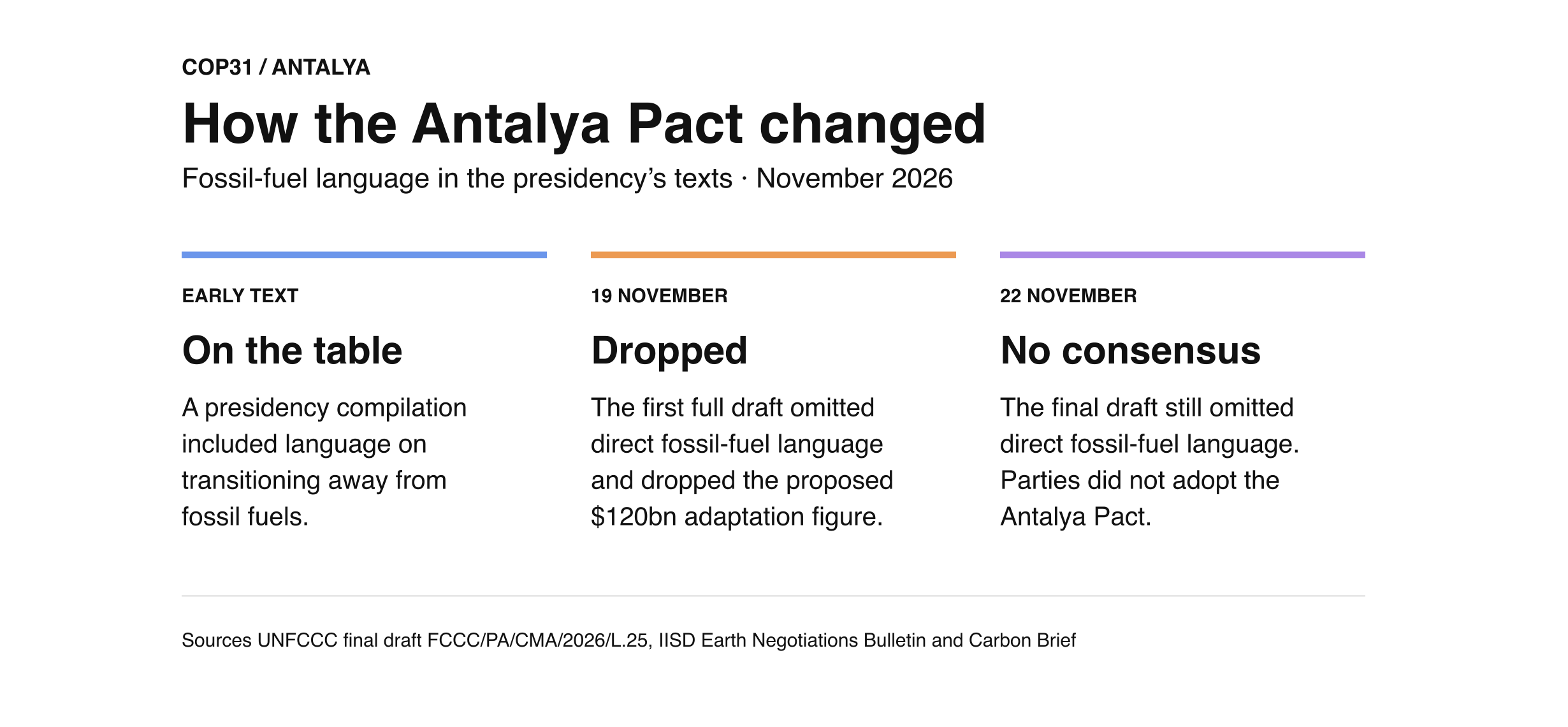
An early presidency text gathered proposals from delegations, including language on transitioning away from fossil fuels. The first full draft, released on November 19, omitted that language and dropped a proposed $120 billion figure for adaptation finance.
A broad coalition then proposed restoring the substance of the Dubai agreement through a direct reference to the first global stocktake, the UN’s assessment of collective progress under the Paris Agreement. As reported by Carbon Brief, the coalition’s amendment would have pointed back to the earlier agreement without spelling out the words “fossil fuels.” It also sought to remove numerical targets for carbon capture, utilization and storage.
The final draft kept a goal of raising electricity to 35% of global final energy consumption by 2035. It also included a collective aspiration to deploy carbon capture, utilization and storage at gigatonne scale by that year. The fossil-fuel transition language stayed out. Countries thus faced a text that was specific about some technologies and left the future of fossil fuels to a general reference to an earlier agreement.
What delegations wanted
| Country or group | Publicly stated position | Where it stood on the final draft |
|---|---|---|
| European Union | Wanted a stronger response to climate science and to carry forward the Dubai commitment on transitioning away from fossil fuels. | Opposed adoption, pointing to the absence of fossil-fuel language. |
| United Kingdom | Called for a response to the risk of exceeding 1.5°C grounded in IPCC science, alongside a transition away from fossil fuels and faster electrification. | Said it could not support the outcome. |
| Panama | Called for stronger action, including a cap on oil production in an open letter. It also criticized the draft’s reliance on carbon capture. | Opposed adoption, arguing that the text weakened previous agreements. |
| Vanuatu and the Marshall Islands | Both objected to what they saw as measures that would protect fossil-fuel interests. Vanuatu also argued that the text fell short of climate science, international law and the needs of vulnerable island communities. | Opposed adoption. |
| Least Developed Countries | Wanted stronger commitments on adaptation finance, including tripling funding and expanding access to concessional finance. They also called for a stronger response to the risk of exceeding 1.5°C. | Called the draft weak on finance and the response to overshoot. |
| African Group, represented by Ghana | Wanted a clear baseline or monetary figure for tripling adaptation finance and stronger assurances that funding would be delivered. | Indicated it could accept the draft despite those shortcomings. |
| Arab Group, represented by Saudi Arabia | Sought clearer finance commitments and raised historical emissions. It opposed top-down targets for specific energy sources and defended a role for carbon capture. | Indicated it could accept the draft despite its concerns. |
| Russia | Opposed fossil-fuel wording and argued that oil and gas would continue to play a role even in pathways aimed at limiting warming to 1.5°C. | Publicly defended its opposition to including fossil-fuel language in the text. |
| Türkiye and Australia, the conference leadership | Promoted faster implementation and an electrification goal of 35% by 2035. Australia’s negotiating presidency also sought language on exceeding 1.5°C. | The presidency put forward the draft, which failed to gain consensus. |
These are documented positions from the negotiations, the closing plenary and public statements. Delegations sometimes spoke for a coalition, and a statement on one issue does not establish everything a country sought in closed-door talks.
Why finance mattered as much as the energy language
The final draft still called for efforts to at least triple adaptation finance by 2035. It proposed a technical report on possible baselines and further talks on how to deliver the increase. For the African Group, the missing benchmark mattered. A commitment to triple funding means different things depending on the starting year, the amount counted and which forms of finance qualify. The draft deferred some of those questions, and the proposed $120 billion figure had already been dropped.
That helps explain why countries with overlapping concerns took different positions on the final text. The African Group was willing to accept a draft it considered insufficient on adaptation finance. Small island states could also press for more funding while concluding that the weakening of the energy language made the overall package unacceptable. The closing plenary recorded both the objections and the willingness of other delegations to proceed.
What survived Antalya
The rejection of the pact left COP31 without an overarching decision. It also left some separate agenda items unresolved, including the future of a mitigation work programme. Other decisions went through, including on climate finance, adaptation and preparations for the next global stocktake. The presidency’s electrification pledge also continued as a voluntary initiative outside the rejected pact.
The next test comes at COP32 in Ethiopia. Antalya left two questions open that will matter there: how governments turn the Dubai fossil-fuel commitment into action, and how developing countries can tell whether promised adaptation finance is actually being delivered.
Photo: Xuthoria via Wikimedia Commons (CC BY-SA 4.0). Resized and cropped for display. Original photograph · License

Sources
- UNFCCC, final Antalya Pact draft under the Paris Agreement
- UNFCCC, companion Antalya Pact draft under the Convention
- UNFCCC, official summary of COP31 outcomes
- UNFCCC, COP31 closing plenary webcast
- Carbon Brief, COP31 negotiations and changes to the draft
- UK government, COP31 outcomes and the UK position