
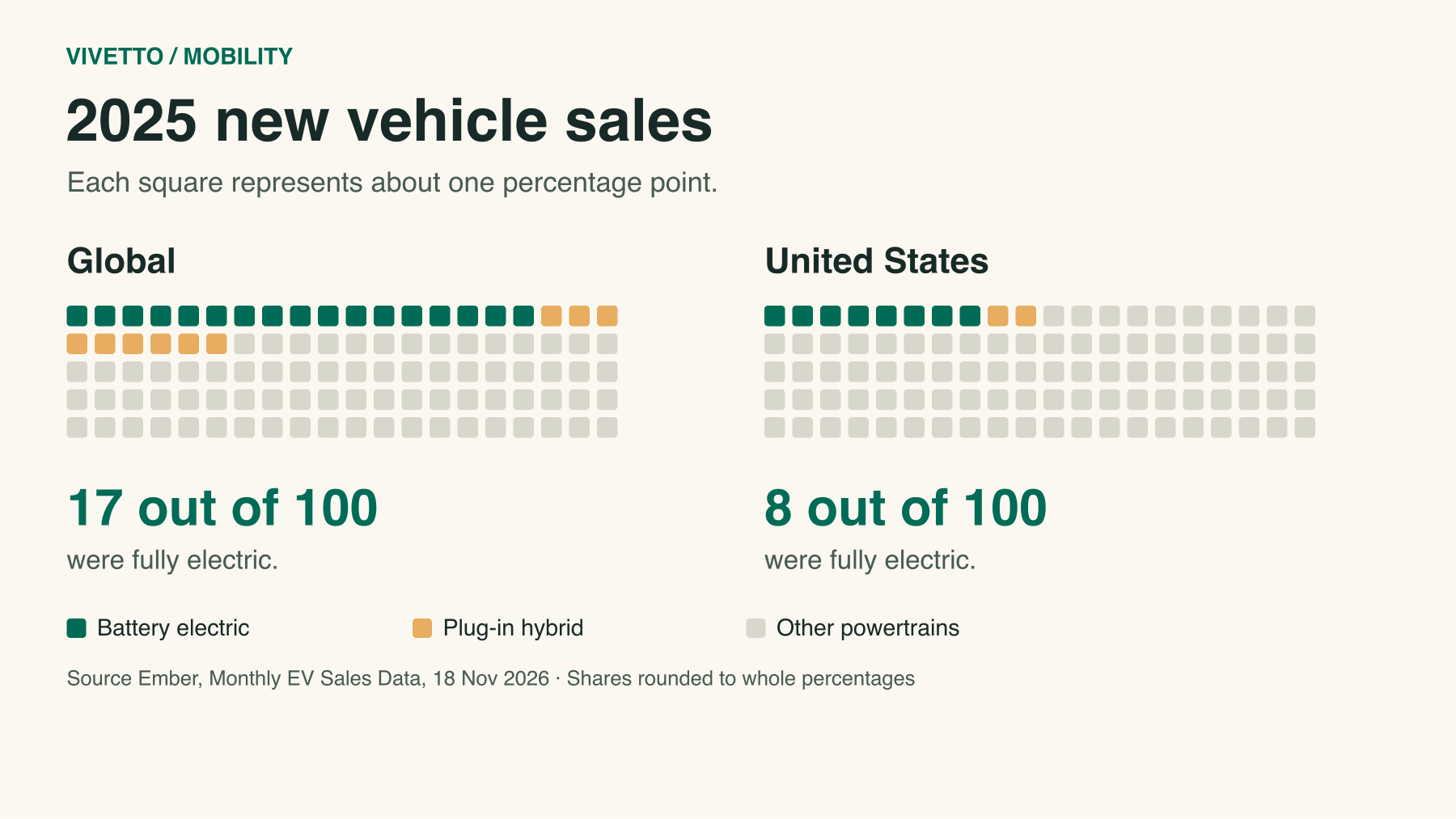
In 2025, one in six new vehicles sold worldwide was fully electric. In the United States, it was one in thirteen. Through October 2026, that gap widened as electric car sales rose globally and fell in the US.
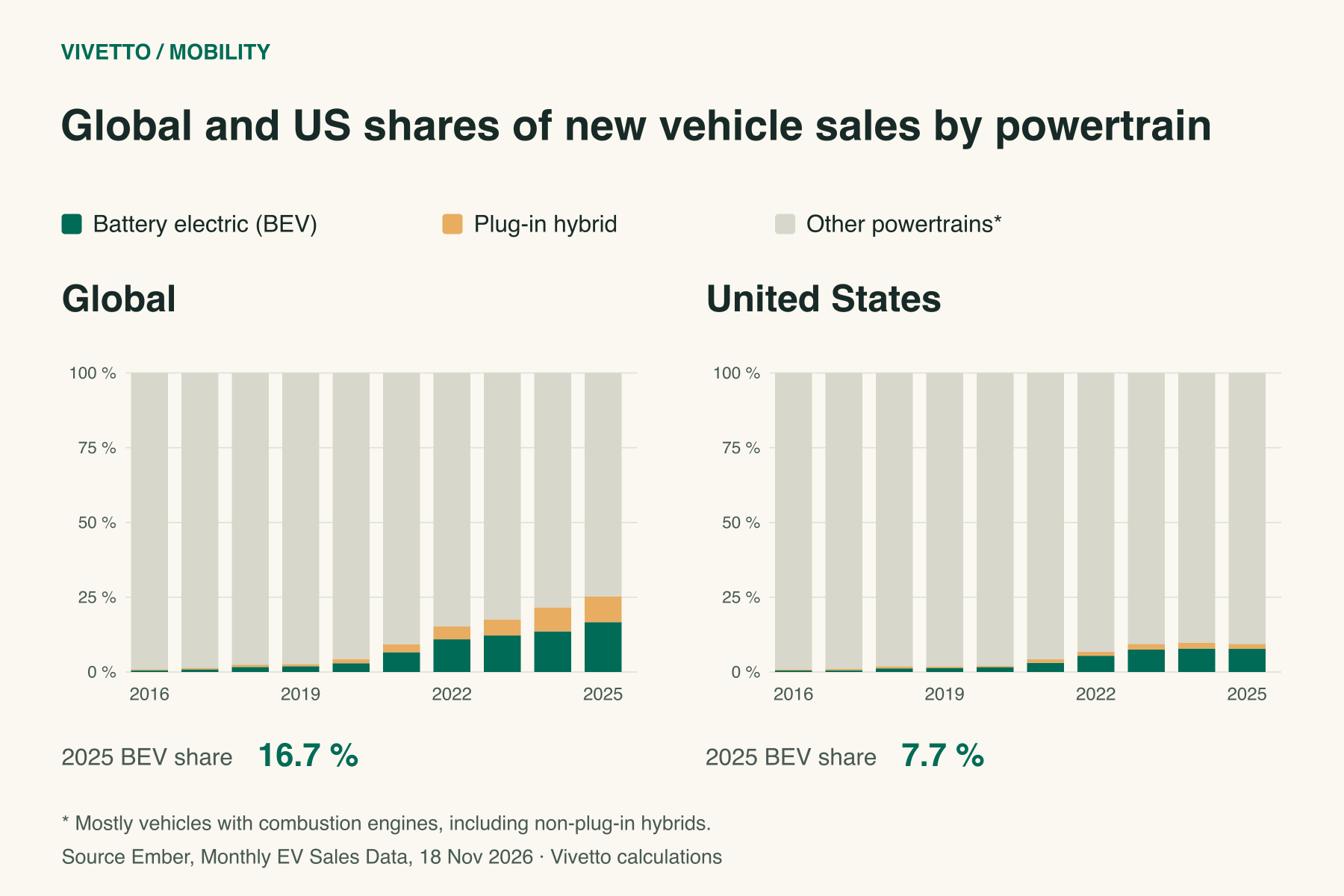
A decade ago, fully electric cars accounted for less than 1% of new vehicle sales in both the United States and the world as a whole. By 2025, battery-electric vehicles had reached 16.7% of global sales and 7.7% of US sales. The latest figures show the two markets moving in opposite directions. From January through October 2026, global sales of fully electric cars rose 11% from the same period a year earlier. In the US, they fell 27%.
How electric car sales diverged after 2020
From 2016 to 2020, global sales of fully electric cars climbed from about 470,000 to 2 million. Then the market accelerated. Sales reached 4.7 million in 2021 and 7.3 million in 2022. Global new vehicle sales actually fell in 2022, while battery-electric sales grew about 55%. For the first time, fully electric vehicles accounted for more than one in ten sales worldwide.
The US also grew rapidly at first. Battery-electric sales rose from about 239,000 in 2020 to 1.16 million in 2023, taking their share of the US market to 7.5%. Growth then slowed. The US sold about 1.24 million battery-electric vehicles in 2024 and 1.26 million in 2025. That modest increase in volume came as the broader US market grew faster, so the battery-electric share edged down from 7.8% to 7.7%. Over the same year, the global share climbed from 13.6% to 16.7%.
China drove much of the global increase
Worldwide, buyers purchased about 14 million fully electric cars in 2025, up from 11 million a year earlier. China alone sold about 7.9 million. Its increase of roughly 1.5 million accounted for about half the global gain. The International Energy Agency points to intense competition among Chinese automakers, attractive prices and a wider choice of models as factors behind adoption.
The longer view shows how much the sales mix has shifted. From 2016 to 2025, the global market grew from roughly 82 million to 84 million new vehicles. Over that period, sales in the group made up mostly of vehicles with combustion engines, including non-plug-in hybrids, fell from about 81 million to 63 million. Plug-in hybrids, counted separately, rose from roughly 310,000 to 7.2 million. The shift toward vehicles that can run on electricity has been substantial, even though vehicles with combustion engines still account for most new sales.
In the US, conventional hybrids gained ground
The fastest shift in the US sales mix in 2025 was toward hybrids without a plug. Sales of those models rose from 1.61 million to 2.08 million, an increase of about 29%. They outsold fully electric vehicles by roughly 825,000 units. US plug-in hybrid sales fell from about 319,000 to 271,000 over the same period. Lumping all three technologies together as “electrified” would obscure what buyers were choosing.
The annual numbers also hide a turning point in the fall. Federal clean vehicle tax credits ended for vehicles acquired after September 30, 2025. Cox Automotive reports that buyers rushed to purchase vehicles ahead of the deadline, helping make the third quarter of 2025 a record for US electric vehicle sales. A year later, Kelley Blue Book estimated that fully electric sales were down nearly 40% from that record quarter. They were also up about 6% from the preceding quarter, a sign that sales had begun to recover from a lower level.
The US gap in electric car sales widened in 2026
| Market | BEV sales, Jan–Oct 2025 | BEV sales, Jan–Oct 2026 | Change | Share of new sales |
|---|---|---|---|---|
| Global | 11.21 million | 12.44 million | +11% | 16.2% → 18.9% |
| United States | 1.13 million | 0.83 million | −27% | 8.3% → 6.2% |
The gap widened from about 8 to nearly 13 percentage points. Worldwide, buyers purchased about 1.2 million more fully electric vehicles even as total new vehicle sales fell by around 3 million. In the US, the overall market shrank by just 1.5%, while fully electric sales fell more than 25%. A weaker US auto market explains only a small part of the drop in battery-electric sales.
The US sold more than five times as many fully electric vehicles in 2025 as it did in 2020. But the baseline for comparison has moved. In the first ten months of 2026, nearly one in five new vehicles sold worldwide was fully electric. In the US, the figure was about one in sixteen.
Read more of Vivetto’s mobility coverage.
About the data
Battery-electric vehicles (BEVs) run entirely on batteries. Plug-in hybrids combine an externally rechargeable battery with a combustion engine and appear separately in the graphics. The remaining category is mostly gasoline and diesel vehicles and hybrids without a plug. It also includes other technologies, such as fuel cells, so the global data do not support a separate count for conventional gasoline and diesel vehicles.
The figures cover new vehicle sales or first registrations. For the US, Ember uses Argonne National Laboratory data covering light-duty vehicles, including cars, SUVs, pickups and vans. Ember estimates global monthly sales from available country data and scales the results to annual totals from the International Energy Agency. The chart uses full calendar years from 2016 through 2025. The 2026 comparison covers January through October in both years. Data are from Ember’s November 18, 2026 release, and recent estimates may be revised.
Graphics: Vivetto (own illustration), based on Ember’s Monthly EV Sales Data.