
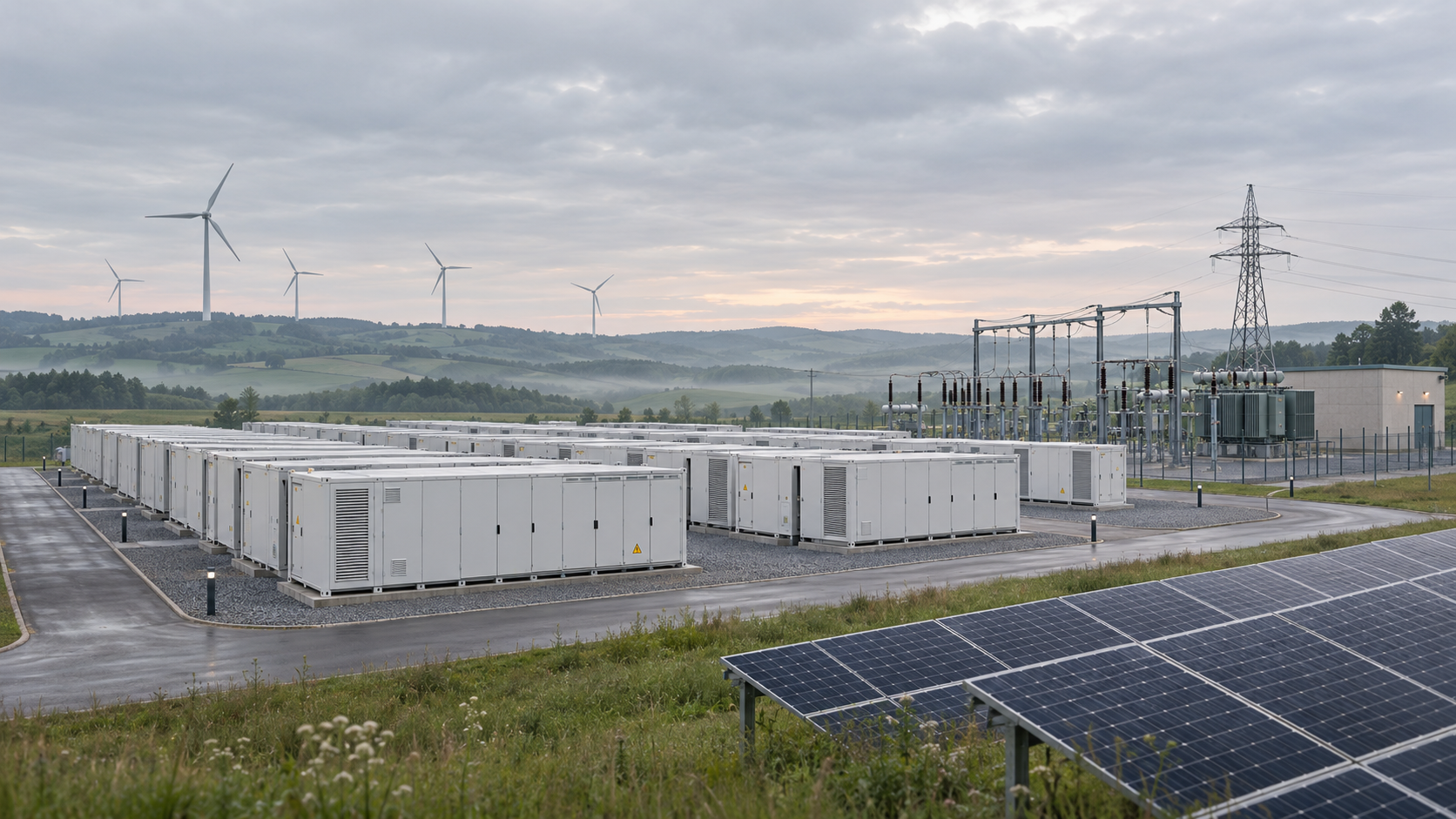
Solar panels can flood the grid with electricity at midday, then produce little or nothing when households need power in the evening. A windy night presents a different version of the same problem: turbines can generate more electricity than customers nearby need or power lines can carry away. Grid-scale batteries give operators another option. They store some of that surplus and return it to the grid when it is needed. 1
Europe is already building storage at scale. SolarPower Europe reports that 36 gigawatt-hours (GWh) of new battery storage were installed across Europe in 2025, taking operational capacity above 100 GWh. Utility-scale projects accounted for more than half of new installations. The key question is what this growing capacity can do for the power system. 2
From midday surplus to evening supply
A battery can charge when renewable output is abundant and discharge after sunset, when solar generation falls but demand remains high. At a solar farm with a shared grid connection, it can also capture electricity that might otherwise be curtailed. A battery can do this only while it has room to charge; once full, it cannot absorb more surplus until it discharges. 1
Two numbers help explain what a battery can deliver. Megawatts (MW) measure how much power it can supply at once. Megawatt-hours (MWh) measure how much energy it can deliver over time. A fully charged battery rated at 100 MW with 400 MWh of usable energy can supply its full output for four hours. Batteries can also respond quickly to help keep grid frequency steady. That service is different from supplying power through the evening, even when one battery provides both. 1
Location matters as much as size
A battery can ease a local bottleneck by charging where wind or solar output would otherwise be curtailed, then discharging when the network has room. But charging can make congestion worse if it adds demand in an area already struggling to import enough electricity. Wholesale prices can signal when power is cheap across a market zone without showing what is happening at a particular substation. Local grid conditions and operating rules matter. 3
In Noord-Brabant in the Netherlands, RWE has made a final investment decision for a 400 MW, 1,100 MWh battery at its Moerdijk power station site. The project is designed to use an existing substation and agreements with transmission operator TenneT to help relieve congestion. Commissioning is planned for the second quarter of 2028, so its effect on the bottleneck is not yet known. 4
Paying for the flexibility the grid needs
Battery owners can earn money by buying electricity when it is cheap and selling it when prices rise, or by providing balancing services. Some systems also use auctions to secure storage in particular regions ahead of time. In September 2025, Italy’s transmission operator Terna awarded contracts for 10 GWh of storage capacity in southern Italy and the islands, with the contracted facilities scheduled to enter service in 2028. 5
What makes money for a battery operator does not always cut emissions. Some energy is lost during charging and discharging. If a battery charges with electricity from fossil fuels and later displaces generation that is no cleaner, those losses can raise emissions. The strongest climate benefit comes when a battery absorbs renewable output that would otherwise be curtailed and displaces fossil generation later. Research from the University of Birmingham finds that storage’s emissions impact depends on where and how it operates. 6
A solution for hours, not every shortfall
A four-hour battery can help cover an evening peak, but it cannot bridge several days of low wind and solar output without a chance to recharge. Europe will still need stronger grids, cross-border links that let regions share power, and ways to shift demand into hours when electricity is plentiful. Longer-duration storage and other sources of dependable power can help cover gaps that last beyond a battery’s discharge window. 1
The test for a new battery is not just how many megawatt-hours it adds. It is whether it can charge where clean power would otherwise go unused and discharge where and when the grid needs it. Get those decisions right, and Europe can make better use of the wind and solar farms it has already built. 136
Sources & further reading
- Flexibility — Electricity 2026, International Energy Agency.
- European Battery Market Outlook 2026–2030, SolarPower Europe.
- EU Electricity Market Integration: 2026 Monitoring Report, ACER.
- RWE to build 400 MW battery to ease grid congestion in Noord-Brabant, RWE.
- Terna completes first MACSE auction: 10 GWh of energy storage capacity awarded, Terna.
- Using electricity storage to reduce greenhouse gas emissions, University of Birmingham.